

Wordscapes: Word puzzle game
PeopleFun
Wordscapes is the kind of word puzzle game I can open for a few quiet minutes and still enjoy when I have more time. Its basic idea is easy to understand: connect letters to form words, complete compact puzzles, and move through a sequence of relaxing scenes. That simplicity is exactly why it works so well on a phone. I do not need a tutorial-heavy commitment before playing, and I can stop after one puzzle without feeling that I have abandoned a complicated campaign.
After spending time with it, I found a game that sits between a crossword, an anagram challenge, and a casual daily habit. It is made by PeopleFun and is available free of charge, with optional in-app purchases listed from $0.99 to $99.99 per item. That purchase range is worth knowing before you start, especially if you are looking for a completely pressure-free experience. The game is rated for Everyone, and its broad appeal is reflected in an average rating of 4.5 from around 1.4 million ratings.
How the puzzle loop feels in everyday play
Each round gives me a group of letters and a set of spaces to fill. I rearrange the letters in different combinations, looking for the words that fit. The early puzzles are welcoming because the possible answers feel discoverable rather than obscure. As I move forward, the same small group of letters becomes more demanding: familiar words may be hidden among less obvious combinations, and a puzzle that looks simple can take longer than expected.
Related News

How Android and iOS Updates Transform Pizza Ready! Gameplay

Idle Lumber Empire: Tycoon Inc – The Ultimate Simulation Game

Piano Star: The Music Game Revolutionizing Mobile Engagement
The short format makes Wordscapes particularly suitable for ordinary moments. I can play while waiting for an appointment, during a short commute when I am not driving, or at the end of the day when I want something more active than scrolling. A realistic routine would be opening it with a cup of coffee, solving a handful of boards, and putting the phone down before the morning gets busy. It does not require me to remember a story, manage an inventory, or coordinate with other players before I can begin.
The visual presentation supports that relaxed rhythm. Landscapes give the progression a sense of place, but they do not overwhelm the wordplay. I appreciate that the scenery acts as a calm background rather than competing with the letters. The result is more peaceful than many brightly animated puzzle games, although players who prefer a sharper, more competitive presentation may find it too gentle.
Related News

Why WhatsApp Messenger Still Makes Everyday Communication Feel Easy

Jurassic World: The Game Is the Better Dino Tycoon for Strategic Players

Threads in Real Life: Who Should Join, Lurk, or Leave

How SHEIN Turned Shopping Into an Endless Content Feed

How to Make Fortnite Feel Smarter on Mobile

Should You Switch to Microsoft Outlook on Mobile?
One useful habit is to treat every puzzle as a search problem rather than immediately guessing randomly. I first look for short, obvious words, then test familiar endings and beginnings, and finally drag through combinations I would not normally consider. This approach is more satisfying than spending hints at the first sign of difficulty. It also makes the game feel like a vocabulary exercise instead of a simple tapping routine.
Small discoveries make the boards more rewarding
The main answers are only part of what makes a board interesting. I often find extra valid words that do not belong in the displayed spaces. These discoveries give me something to do after the obvious answers are gone, and they reward experimentation without changing the central objective. For players who enjoy completion, searching for these additional words can turn a quick round into a longer session.
There is a practical trade-off here. Extra-word hunting is enjoyable when I am relaxed, but it can also make a short break expand into a much longer session. If I am trying to limit screen time, I need to decide in advance whether I am solving the board or chasing every possible combination. That distinction is easy to overlook because the game makes continued tapping feel harmless.
Gallery
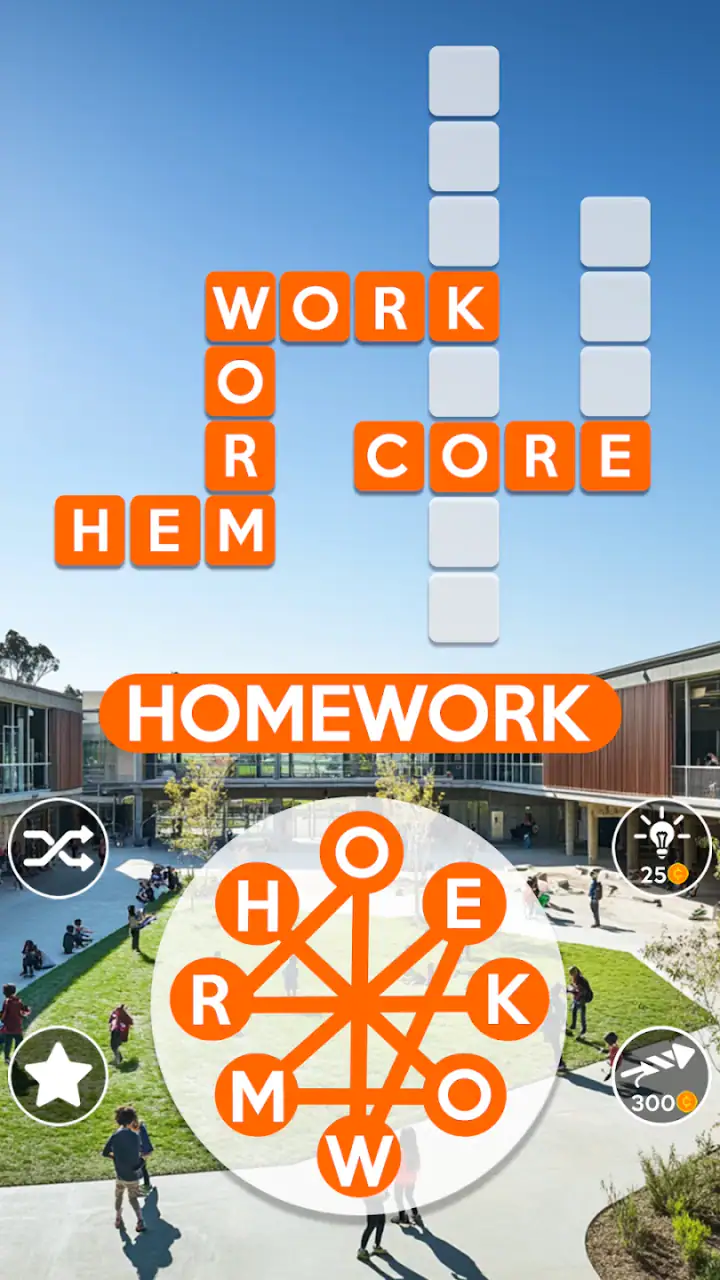
Hints are most useful when I use them as a final nudge rather than a default solution. When I am stuck, I prefer to scan the letters again, try a different word length, and look for a common plural or verb form before spending assistance. This preserves the satisfaction of solving the puzzle myself. The game is at its best when help remains a backup, not the main way I progress.
Progress is comfortable, but it can create its own pressure
Moving through the landscape-based progression gives the game a gentle sense of momentum. Completing boards feels more meaningful than solving isolated puzzles because each success contributes to a visible journey. That structure is helpful for players who need a reason to return, but it also introduces a mild pressure to keep advancing. A game that begins as a relaxing break can become a personal challenge to clear “just one more” board.
This matters for different kinds of players. If you like gradual goals and repeated practice, the progression is motivating. If you prefer a puzzle collection where every challenge is immediately available, the sequence may feel restrictive. I would choose this game for a steady, low-friction routine rather than for a carefully curated set of difficult brainteasers.
The difficulty also depends on your vocabulary and on how comfortable you are with rearranging letters. A board can be easy for one player and unexpectedly stubborn for another. That variation is part of the appeal, but it means the experience is not perfectly predictable. Someone looking for a consistent difficulty curve may occasionally feel that a puzzle has jumped ahead of their current ability.
Spending, fairness, and what I would watch before paying
The free entry point is a strong advantage. I can try the core word-puzzle loop without committing money first, which makes it easy to decide whether the pace and presentation suit me. At the same time, the presence of optional purchases means I would approach the game with a clear personal rule: play naturally first, and only consider spending if the experience remains enjoyable without constant assistance.
The listed purchase range is wide, from $0.99 to $99.99 per item. That does not automatically make the game unfair, but it does make spending awareness important. I would not treat a large purchase as a sensible shortcut simply because a difficult board is frustrating. For a casual word game, the most responsible approach is to set a budget outside the app and avoid making a decision while trying to force progress.
I also recommend checking the purchase confirmation carefully, particularly if children use the device. The Everyone rating makes the game accessible to a broad audience, but an age rating does not remove the need for sensible spending controls. Parents who are comfortable with the puzzle content may still want to manage how optional purchases are handled on the phone or tablet.
From a fairness perspective, the most important question is whether I can enjoy the central activity without paying. In my experience, the answer is yes: solving word boards remains the reason to play, and I do not need to buy anything to understand the basic appeal. The pressure appears more psychological than mechanical. When I am stuck, I may be tempted to use help or seek a quicker route, but choosing patience keeps the game feeling fair to me.
Does competition change the spending question?
Wordscapes can feel competitive even when I am playing alone because progress creates personal targets and encourages comparison with my previous performance. That is different from a game where purchases directly decide a match between players. I would therefore judge its fairness mainly by how much pressure I feel to accelerate my own progress, not by whether someone can simply outspend me in a live contest.
For players who enjoy word games as private relaxation, this is a comfortable distinction. I can ignore any urge to keep pace with others and focus on solving at my own speed. For players who turn every progression system into a race, optional purchases may feel more significant because they can make the natural pace seem slower. In that situation, the game may be less relaxing than its scenery suggests.
I would also separate skill from persistence. Solving a board without help feels like a genuine vocabulary and pattern-recognition achievement. Using assistance can remove that challenge, even if it makes progress smoother. My advice is to reserve help for moments when the puzzle has stopped being fun, rather than treating it as part of an optimal strategy.
Version, device expectations, and long-term use
The current version is 3.7.1, and the game requires Android 7.0 or later. That makes it a practical option for many Android users, including people who do not replace their phones frequently. Before installing, I would still check the operating system on an older device, especially if the phone has been kept for several years.
Wordscapes has reached over 100 million installs, so it is clearly not an obscure experiment with a tiny audience. That scale can be reassuring when I want a familiar, established word game rather than a title that may disappear after a short period. It does not guarantee that every player will enjoy the design, but it suggests that the basic format has broad staying power.
The game is free, which lowers the risk of trying it, but free installation should not be confused with an entirely cost-free environment. I would make the purchase decision separately from the download decision. Install it to test the puzzle loop; only think about spending after you know whether you like the pace, the progression, and the way assistance fits into your play.
Who should choose it, and who should skip it?
I would recommend Wordscapes to someone who wants a calm vocabulary game that works in short sessions. It is especially suitable for players who like anagrams, compact crossword-style challenges, scenic presentation, and gradual progression. It can also be a pleasant choice for a household where different people want to play independently, since the basic interaction is easy to understand and the content is suitable for Everyone.
I would be more cautious recommending it to someone who wants advanced crossword construction, strict dictionary depth, or a competitive word-game environment where every move has strategic consequences. This is not the best substitute for a dedicated crossword app, a head-to-head word battle, or a puzzle platform built around unusually difficult clues. Those alternatives are better when you want richer clue interpretation, direct competition, or more control over challenge selection.
It may also disappoint players who dislike repeated patterns. The letter rearrangement format is approachable, but it naturally revisits familiar types of words and word lengths. If you need constant mechanical variety, the peaceful consistency can start to feel repetitive. I would choose a broader puzzle collection instead if I wanted logic grids, numbers, visual puzzles, and wordplay all in one place.
Another trade-off is the balance between relaxation and compulsion. The boards are small enough to invite another attempt, and the progression gives that attempt a clear purpose. That is useful when I need a gentle focus activity, but less useful when I am trying to put my phone away. A timer or a personal stopping point can help keep the game in the role of a break rather than letting it fill every spare moment.
My trust verdict after using it
What I trust most about the experience is its clarity. I know what I am doing as soon as a puzzle opens, and the central reward comes from recognizing words rather than learning a complicated system. The free starting point lets me judge the game on its actual feel. Its broad audience, Everyone rating, and established presence also make it an easy recommendation for casual players who want something approachable.
What I would keep in mind is the spending range and the way progression can encourage continued play. Optional purchases from $0.99 to $99.99 per item are a reason to use sensible device controls and a personal budget, not a reason to assume the game is automatically unsuitable. I can enjoy the boards without paying, but I still need to be deliberate if I am prone to buying help when stuck.
In the end, I see Wordscapes as a dependable word puzzle game rather than a deep competitive platform. Its best qualities are the low learning curve, the pleasant landscape setting, the satisfaction of uncovering extra words, and the ability to fit a board into an ordinary day. Its weaker side is the possibility that steady progression and optional assistance turn a calm pastime into a habit that asks for more time or money than I intended.
If you want a friendly anagram game to play while waiting, winding down, or building a small daily vocabulary routine, I think it is worth trying. I would start without spending, decide how much help I am willing to use, and judge the experience by whether solving the words remains enjoyable. For me, that is the fair way to approach this free word game: let the puzzles provide the satisfaction, and keep the optional spending firmly under my control.
FAQs for Wordscapes: Word puzzle game
What is the main objective of Wordscapes?
Wordscapes is a word puzzle game that challenges players to find all possible word combinations from a set of letters. The main objective is to fill the crossword-style grid by creating words, enhancing vocabulary, and solving increasingly difficult levels as you progress. It combines elements of anagrams and crosswords.
Is Wordscapes free to play?
Yes, Wordscapes is free to download and play, but it offers in-app purchases. These purchases can enhance gameplay by allowing players to buy hints or remove ads. While the game is enjoyable without spending money, some players may find these purchases helpful for progressing through tougher levels.
Does Wordscapes require an internet connection?
Wordscapes can be played offline, making it a great option for playing on the go without worrying about data usage. However, an internet connection is needed to access certain features, such as purchasing hints or syncing progress across multiple devices.
Can I sync my Wordscapes progress across multiple devices?
Yes, you can sync your progress across multiple devices by connecting the game to your Facebook account. This feature ensures that you can continue your game seamlessly, regardless of which device you use, and protects your progress if you switch phones or tablets.
Are there any ads in Wordscapes, and can they be removed?
Wordscapes does have advertisements, which appear between levels or after using specific features. Players can opt to remove ads by making an in-app purchase. This purchase not only enhances the gaming experience by providing uninterrupted play but also supports the developers.
Pros
- Beautiful
- calming graphics enhance gameplay.
- Wide variety of puzzles keeps it engaging.
- Offline mode available for on-the-go play.
- Regular updates with new levels and features.
- Boosts vocabulary and cognitive skills.
Cons
- In-app purchases can get expensive.
- Ads can interrupt gameplay frequently.
- Limited hints without spending money.
- Repetitive themes in higher levels.
- Battery consumption can be high.


